Moldova – socio-economic impact assessment (2022)

Overview

The study assesses the economic, social and environmental impacts of creating a Spatial Data Infrastructure (SDI) for Moldova and quantifies the net benefits where feasible. It adopts the World Bank methodology developed under the Global Geospatial project and United Nations guidelines for implementing an Integrated Geospatial Information Framework (IGIF) on which a future SDI will be built.


The current state of Moldova is assessed using the World Bank diagnostic tool. Key strengths are identified in governance, innovation, and data; key weaknesses correlate to finance, education/capacity, and communication/engagement.


The study recommends priority areas for strategic investment over a five-year period. The required investment is composed of core data and technology projects with supporting governance, legal, financial management, partnership development and human capacity building measures. The investment outlined in the report would deliver an SDI that is nationally complete, authoritative, up to date and of an appropriate quality to underpin development of the economy of Moldova and facilitate improving the welfare of its people.

Geographical scope

Moldova

Non-quantified impacts

The overall target outcome for the SDI is to lead to the efficient, equitable and optimal utilisation and management of geospatial information applied across all sectors of the economy. To ensure optimal alignment, the study analyses a wide range of Government policies and commitments. Based on this analysis, the following sectors are those where, it believes, geospatial information generally and the SDI particularly, can make the most significant and positive impact:

  • Economic and Urban Planning
  • Land Management and Administration
  • e-Government
  • Transport
  • Disaster Risk Management and Emergency Services
  • Agriculture
  • Forestry and Fishing
  • Health and Social Care
  • Natural Resources
  • Water and Hydrology
  • Energy
  • Environment and Tourism
  • Local Government
  • Commercial
  • Multi-sector

Quantifiable impacts

Cost-Benefit Analysis

The financial values for the investment plan and on-going recurrent expenditure were entered into a discounted cash flow spreadsheet to calculate the likely Return on Investment (RoI) using a standard cost-benefit analysis approach. The results for the mean case are summarised in the table below (units are Thousands):
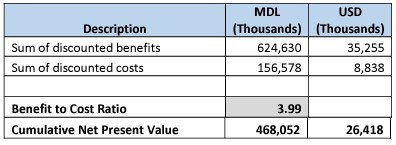
 

Cost-benefit analysis (mean case)


The cash flow forecast is shown in the chart below and detailed in section 6 of the report.
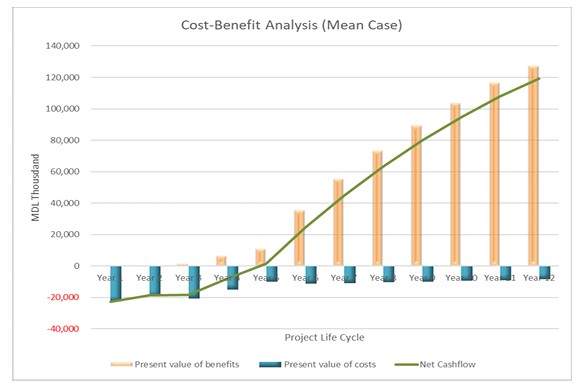
 

Cost-benefit forecast (mean case)


The assessment is based upon quantification of 20% of the identified use cases. The authors stress that if data and time were not constrained, and more case studies had been quantified, it is their expert opinion that the calculated RoI would be significantly higher. The process was subject to sensitivity analysis, confirming the robustness of assessment.


Reference

Country

Study type

Desk-based research, Subject matter expert interviews, Cost-benefit analysis

Economy sector

Education, Infrastructure (Transport), Infrastructure (ICT), Infrastructure (Energy), Health, Public Safety and Security, Disaster Risk Management, Real Estate and Land Administration, Design and Construction, Public Sector Local Government, Public Sector Central Government, Environment, Agriculture