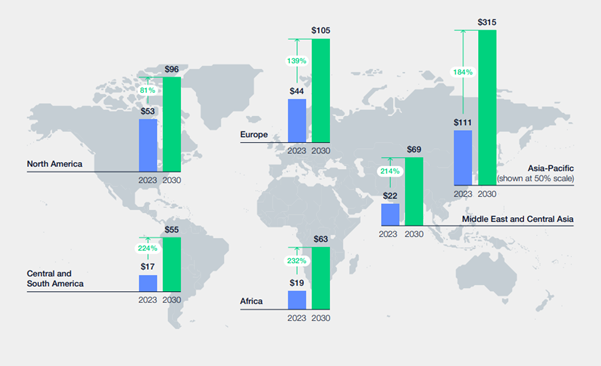
Regional growth story visualisation
Source: Deloitte/World Economic Forum
The study finds that with encouraging market trends and hundreds of possible applications, the global potential of EO is immense, but the extent of this potential has not yet been realised. It estimates the potential value-added from EO data at USD 266 billion (nominal US dollars are used throughout the report) in 2023, a figure that is poised to grow to more than USD 700 billion in 2030 with a cumulative USD 3.8 trillion contribution to global gross domestic product between 2023-2030. Most of that value comes from downstream applications in industry; approximately 94% of the total value possible by 2030 derives from applications in agriculture, electricity and utilities, government, public and emergency services, insurance and financial services, mining, oil and gas, and supply chain and transport.
EO can also support initiatives that generate environmental benefits. It is a critical tool to inform policies, decisions and interventions that could eliminate up to 2 gigatonnes of greenhouse gas emissions every year while supporting a host of nature-positive strategies. The report highlights that this figure is likely to be an underestimate, as it only considers five leading EO applications with a demonstrated direct impact on GHG emissions, while numerous others exist with indirect effects. However, it still equates to approximately 3.6% of annual global emissions today (according to the United Nations Environment Programme’s, Emissions Gap Report 2023).
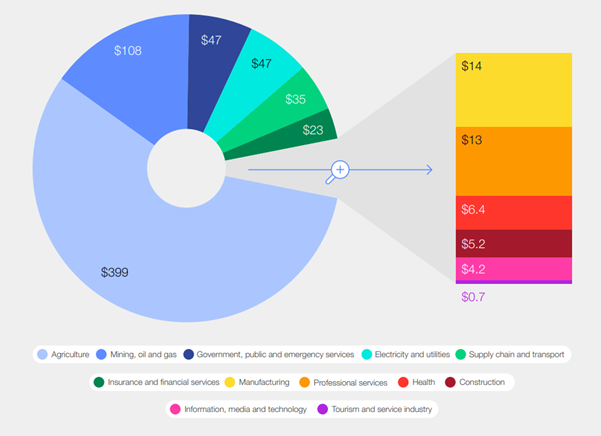
Potential global economic value from EO data, by industry, in 2030 (USD billions).
Source: Deloitte/World Economic Forum
Earth observation’s 6 key industries
Applications in six key industries are responsible for 94% of Earth observation’s total value possible by 2030.
- Agriculture
The uses of EO data in the agriculture industry are expansive with applications used in areas such as cropping, timber, livestock and fisheries. Remote sensing and in-situ data allow for better informed decisions for modern processes in farming at optimal times. This insight can also reduce up to 27 megatons (Mt) of GHG emissions annually from fertilizers.
- Electricity and utilities
The early adopters of EO in the energy and utilities industry have gained an information advantage in areas that span from site selection to management of transmission infrastructure. Applications for renewables, like forecasting energy potential for new solar, wind and hydropower sites, emerge as key enablers to the expected proliferation of renewable energy this decade.
- Government, public and emergency services
Earth observation was initially government-led and applications for public and emergency services are relatively robust. Accurate modelling of hazards and near real-time monitoring of structures, land and vegetation allow for better disaster preparedness and response. As natural disasters (e.g., floods, wildfires, hurricanes) become more frequent, EO provides a vital tool to protect human lives and capital stock. In the context of wildfires, early warning applications can help eliminate up to 64Mt of GHG emissions per year.
- Insurance and financial services
Insurance companies can use EO data to better assess risk, offer parametric insurance products and find efficiencies in assessing claims. The technology also plays a key role in sustainable finance by enabling independent verification sustainable practices. Financial services and insurance industries can use Earth data to better assess and manage their exposure to risks brought about by biodiversity loss and climate change.
- Mining, oil and gas
EO’s ability to remotely monitor oil and gas extraction and transmission brings both economic and environmental benefits. Using specialized sensors, companies can predict potential damage and quickly detect leaks when they occur. Faster remediation can help limit leaks which not only avoids product losses but can also reduce GHG emissions by as much as 1.7 Gt per year. International Energy Agency estimates that oil and gas companies can use EO to reduce almost 45% of methane emissions from oil and gas operations at no net cost.
- Supply chain and transportation
EO enables traceable supply chain insights for an increasing number of companies focused on ethical sourcing. Companies can not only track physical goods within their own downstream supply chain operations but also upstream in the supply chains of their vendors. As consumers and regulators exert pressure on markets to ethically source products, EO can provide a valuable tool to plan and monitor interventions.